
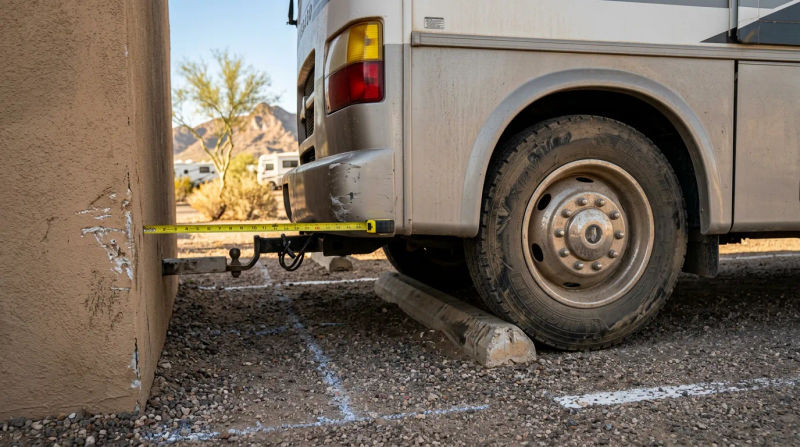
The air is just starting to get that crisp edge as the Buckeye nights cool down. You’ve had a fantastic summer of travel, but now it’s time to park your home-on-wheels for a bit. You pull up to the RV storage facility, confident with your booking, and begin to back into your spot. Then comes that sinking feeling. The rear corner is getting dangerously close to a post, your side mirror is about to scrape the wall, and the back end is still sticking out into the drive lane. You’re just a few inches off, but in this game, a few inches might as well be a mile.
As a facility specialist here in the Buckeye area for nearly a decade, I’ve seen this exact scenario play out more times than I can count, especially in September when everyone is looking for an RV parking space at the same time. A simple measurement mistake can turn a smooth, easy end to your travel season into a stressful scramble for a new spot. My team and I are here to help you avoid that headache. Let's walk through how to identify a sizing problem and, more importantly, how to prevent it from happening in the first place.
Common Signs and Symptoms
You might think a sizing issue is obvious - the RV either fits or it doesn’t. But often, the signs are more subtle until it’s too late. You might have chosen the wrong size space if you experience any of these issues:
- The Squeeze Play: You can get the RV into the spot, but you can’t open your driver-side door wide enough to get out without shimmying. Or worse, you can’t open storage bay doors to access your gear.
- Slide-Out Standstill: You’ve parked the rig, but when you try to extend a slide-out to air out the interior or perform maintenance, it hits a neighboring vehicle, a fence, or a support post.
- The Tail Hang: The front of your RV is perfectly aligned with the front of the space, but the rear ladder or spare tire hangs out into the drive aisle, creating a hazard for other drivers.
- Height Anxiety: As you pull in, you hear a dreaded scrape from above. Your rooftop A/C unit, satellite dish, or vent cover has made contact with the overhead covering or entryway. This is a common issue in covered or enclosed spaces.
- The Turning Point: The space itself is long enough, but you had to make a 10-point turn just to get aligned, scraping tires and stressing your chassis. The access lanes simply didn’t accommodate your rig’s turning radius.
If any of these sound familiar, it’s a clear indicator that the chosen space isn’t a good long-term fit, even if you technically managed to park.
What Causes This Problem
These symptoms almost always stem from a few common oversights during the selection process. Understanding these mistakes is the key to getting it right. Here’s what my team and I see most often:
- Forgetting the “Attachments”: Many owners rely on the manufacturer's listed length. This number often measures from bumper to bumper but excludes anything added on. You must learn how to measure RV for storage space the right way: with a tape measure, from the absolute forward-most point (like a propane tank cover or front hitch) to the absolute rearmost point (like a ladder, spare tire, or bike rack). This is your “overall length,” and it's the only number that matters.
- Thinking in One Dimension: Length is important, but it’s only part of the equation. You need to account for width and height. Measure your RV at its widest point (usually the mirrors) and its tallest point (often the A/C unit). This is crucial for understanding the RV storage spot width and clearance you truly need.
- Ignoring “Active” Space: A parked RV isn't always static. You need space to function. Before booking, think about what you need to do while it's in storage. Do you need to extend an awning to clean it? Do you need to fully open your bay doors? Will you be extending slide-outs? If so, you need a space that accommodates the RV's dimensions when it's fully “active.”
- Overlooking Facility Layout: The space dimensions are one thing; getting to it is another. Here in Buckeye, properties can have very different layouts. Some have wide, straight lanes, while others have tight corners or angled parking. You have to consider the RV turning radius for parking lot navigation. A 45-foot Class A needs a lot more room to maneuver than a 25-foot travel trailer. If the drive aisles are narrow, even a perfectly sized spot can be impossible to get into.
- Confusing “Listed” vs. “Usable” Space: Some facilities list dimensions that include posts or structural elements within the space. A 12-foot wide space might only have 11 feet of usable width between support poles. Always ask if the listed dimensions are completely clear and unobstructed.
- The Digital Guess: Relying solely on online descriptions or photos can be misleading. Photos can distort distances, and descriptions might leave out key details about access or clearance. There is no substitute for either seeing a space in person or having a detailed conversation with someone on-site.
- Not Planning for Doors: This is a classic mistake. You find a space that fits your RV’s width perfectly, but it’s so snug that you can’t open your entry door or compartment doors. A good rule of thumb is to have at least 2-3 feet of extra width beyond your RV’s body to allow for easy access.
When to Call a Professional
Measuring your RV is something you can and should do yourself. Grab a tape measure, a notepad, and a friend to help hold the tape. Measure your total length, width (mirrors included), and height (A/C included). Write these numbers down and keep them handy.
However, the time to consult an expert is before you click “book.” This is where an experienced on-site professional becomes your most valuable asset. While you know your RV, they know their facility inside and out. You can give them your measurements, and they can act as your eyes on the ground.
An experienced professional can tell you:
- “Yes, a 40-foot spot will fit your 38-foot rig, but our drive aisle on that row is tight. Given your RV turning radius for parking lot access, I’d recommend a spot on a different row with straight-in access.”
- “You mentioned needing to access your driver-side bays. The spots on the left side of the aisle will give you more room for that.”
- “Our covered spots have a 14-foot clearance, so your 13'6" tall fifth wheel will fit perfectly.”
Trying to solve a sizing problem on arrival day is stressful, especially during the busy post-summer rush when options are limited. A five-minute phone call with a qualified professional beforehand can save you hours of frustration.
Conclusion
Choosing the right RV parking space isn't just about finding one that’s long enough. It’s about understanding your RV’s true total dimensions, considering how you’ll need to access it, and accounting for the layout of the facility itself. By avoiding common mistakes like forgetting attachments or ignoring your turning radius, you can ensure a perfect fit.
As we move into the fall here in Arizona, demand for good, secure spots is high. Don’t wait until the last minute. Take the time now to measure your rig properly and have a conversation with an expert. A little preparation today ensures your investment is safe, secure, and accessible whenever you need it.
If you're planning for storage and have questions about measuring your rig or what kind of space you might need, contact a local RV storage professional for guidance.